
News
Site News
How Role-Playing Games, Distributed Computing, and AI Development Led to an Investment Pitch Simulator

I've spent close to 50 years working with role-playing games in various capacities—as a player, game master, designer, researcher, and therapeutic practitioner. In parallel, I've been writing code since 1979, building systems that range from simple pattern-matching programs on university mainframes to distributed GPU clusters processing modern AI workloads. These two paths—gaming and computing—have intersected repeatedly throughout my career in ways that weren't always obvious at the time but now seem almost inevitable in retrospect.
A Professional Milestone in Educational Technology and Creator Empowerment

Over the past several years, I've found myself juggling roles across multiple organizations—some overlapping in mission, others completely independent, all working toward making specific impacts in their respective domains. As Chief Information Technology Officer (CITO) of Practicing Musician SPC and CITO + Co-Founder of ClimbHigh.AI, I've been deeply involved in building educational technology platforms that are trying to address some fundamental problems I've observed across decades in both the tech industry and educational spaces.
AI Journey 1977-2025: Part 5 of 5 - SIIMPAF - Four Decades of Technology Lessons in One System

This is Part 5 of a 5-part series documenting the technical evolution from early introduction to role-playing gaming in 1977 and hobby programming in 1979 to modern distributed GPU computing and self-hosted Artificial Intelligence (AI) infrastructure. The series traces patterns that emerged over four decades and shows how they apply to current challenges in AI development and computational independence. This final part brings together four decades of lessons in DGPUNET's, AILCPH's, & SIIMPAF's architecture, explaining how patterns from 1979 remain relevant in 2025.
AI Journey 1977-2025: Part 4 of 5 - Building Distributed GPU Infrastructure When Centralization Threatens Innovation
This part addresses the GPU scarcity challenge and demonstrates how decades-old distributed computing patterns apply to modern AI infrastructure.
AI Journey 1977-2025: Part 3 of 5 Professional Applications and Breakthroughs (2005-2020)
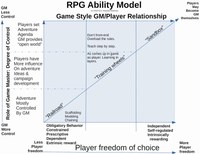
This is Part 3 of a 5-part series documenting the technical evolution from early introduction to role-playing gaming in 1977 and hobby programming in 1979 to modern distributed GPU computing and self-hosted Artificial Intelligence (AI) infrastructure. The series traces patterns that emerged over four decades and shows how they apply to current challenges in AI development and computational independence. This part focuses on applying technical skills to therapeutic and educational contexts, culminating in systems that outperformed commercial alternatives.
Hawke's AI Journey 1977 to 2025: Part 2 of 5 - IRC Bots, Beowulf Clusters, and Distributed Computing on Commodity Hardware

This is Part 2 of a 5-part series documenting the technical evolution from early introduction to role-playing gaming in 1977 and hobby programming in 1979 to modern distributed GPU computing and self-hosted Artificial Intelligence (AI) infrastructure. The series traces patterns that emerged over four decades and shows how they apply to current challenges in AI development and computational independence. This part focuses on scaling patterns from single systems to networks and building production infrastructure on commodity hardware.
My Personal AI Journey 1977 to 2025: Part 1 of 5 - How Role-Playing Games and Early Computing Shaped Four Decades of AI Development

This is Part 1 of a 5-part series documenting the technical evolution from early introduction to role-playing gaming in 1977 and hobby programming in 1979 to modern distributed GPU computing and self-hosted Artificial Intelligence (AI) infrastructure. The series traces patterns that emerged over four decades and shows how they apply to current challenges in AI development and computational independence.
90/10 Rule Applied: Building 3 years and $30M Worth of EdTech in 3 Months for just $100K
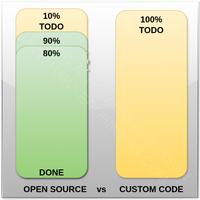
I've watched countless companies burn through millions (billions in the aggregate) trying to reinvent wheels that already exist. Not long ago, I reviewed a competitor's failed attempt to build what we launched in six weeks and less than $20,000 USD for 1.0, and just 3 months and $100k for 2.0 — they spent three years and $30+ million, and they still couldn't deliver. This isn't about being better-funded, or event smarter; it's about the wisdom of understanding a fundamental truth that most of the tech industry refuses to accept: in the 2020s, 90% of what you need has already been built.
From Engine & Drivetrain Repair to Neural Networks: What Automotive Work Taught Me About AI
How diagnostic thinking learned in auto repair shops applies to building, troubleshooting, and improving, artificial intelligence systems.
Freedom to Create: The Relationship Between Open Societies and Innovation
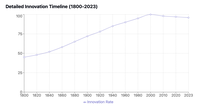
Throughout human history, innovation has followed a fascinating pattern of peaks and valleys, strongly correlated with the degree of societal openness and free exchange of ideas. Recent comprehensive analyses combining archaeological data, historical records, and modern patent statistics reveal a compelling relationship between open societies and accelerated technological progress.
Building DGPUNET: Democratizing AI Innovation Through Open Source Infrastructure
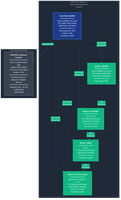
Over the past several months, I've been working on something that started as a practical necessity but evolved into a philosophical statement about accessibility in AI development. When a startup couldn't get anything better than a pitiful G10 GPU instance from their cloud provider - completely insufficient for the machine learning workloads needed - I realized I had to take matters into my own hands, and home...
PoDoSOGoAdmin WebUI Mail Servers Administration Tool - Public Release Very Soon!

There isn't a free and open source combined administration tool for the mail server setup of: Postfix + PostGreSQL + Dovecot + SOGo Webmail, I have created such a tool, and will be releasing it publicly on github as soon as I can create a sanitized version.
Postfix, Dovecot, PostGreSQL, and SOGo Webmail on Debian 13

Debian 13 was fairly recently released, but AWS is already shoving it as the primary AMI, and make getting a good Debian 12 a few more steps. Most apps aren't yet compatible with Debian 13, so I recommend waiting for it to stabilize, but here is some information on getting a basic mail server working on Debian 13...
The 67% Revolution: How ClimbHigh.AI and Its Community Are Rewriting EdTech's Rules

At ClimbHigh.AI (https://www.climbhigh.ai), our team, led by CEO Jake Douglass, is building something revolutionary: a platform where creators own 67% of the content equity. Not revenue sharing. Actual ownership...
The Most Valuable Asset is Time - Please Don't Waste It Sending Low-Value Asynchronous Video Messages - Write

Is anyone else noticing this increasing barrage of asynchronous low-value video messages in your chat messaging (especially in Linkedin)?
The Convergence Executive: Why Tomorrow's Leaders Need Impossibly Broad Expertise

How one technology leader's journey from construction laborer, miner, and automotive repair to neurotechnology reveals the competitive advantage of cross-domain mastery
Claude.ai adds throttling to max users but with no transparecy

I've liked using Claude.ai in many areas, but they are starting to get overwhelmed and have begun throttling "top 5% users", which apparently I am. But they aren't offering ANY transparency about this...
Some of Hawke Robinson's Key CITO Methodologies

I have been involved working with technology since 1979 (over 45 years!), and over time refined the methodologies that help enhance the benefits of technologies to maximize the benefits to business, and help improve the overall human condition.
Why A CTO Should _NOT_ Just Be A Glorified Coder/Engineer

Increasingly, the title “CTO” is being used to induce engineers to provide underpaid—or even free—technical services. Don't fall for it! Otherwise your organization will very likely be ruined.
Hawke Robinson Status Update: A Wide Variety of Tech Projects in December
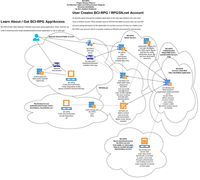
This is a very short summary of some projects I worked on so far this month:
Thoughts on Quantum Computing, "Qomputing", Organic Computing, etc.

I was recently asked on Linkedin for my opinion on Quantum computing, this was my top of head response...
Is the Jan.ai executable infected?
January 9th, 2024, 10:00 am Pacific Time, BitDefender Total Security Alert: @janhq\inference-nitro-extension\dist\bin\win-cpu\nitro.exe is infected with Gen:Variant.Tedy.258323 !
Hawkes-Robinson Projects Model: Project Management, Scoping, Resources, Time, Brook's Law, Tuckman's Theories, and More, combined
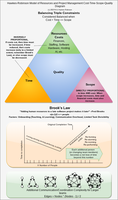
An overview diagram of a number of the theories, methodologies, constructs, and "laws" that I include in all of my projects.
Interaction Patterns and Role-Playing Games
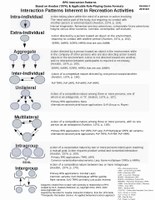
Here is a "cheat sheet" summarizing the "Interaction Patterns" concepts into one page for RPG design. I'm thrilled to see it being adopted by professionals and professors in various universities across the USA for their Certified Therapeutic Recreation Specialist degree and other programs. This short hand tool is useful for explaining and developing role-playing games in various formats and goals. Check out the references for more information on about it!
Status Update August 31st, 2023
A brief status update.
FAQs For Hawke Robinson: World Building

Question: With all of your experience and being a game master, what is your favorite world building approach?
About Hawke Robinson and Role-Playing Gaming

Brief introduction about Hawke Robinson from various interviews.
AI Generated Listing of Hawkes-Robinson Role-Playing Game Models and Theories
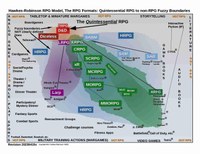
It is funny to see what various Machine Learning (ML) so-called by layperson too readily as "Artificial Intelligence" (AI), create a butchery of the Hawkes-Robinson RPG Models and theories. This posting includes example excerpts from the wackiness that occurs.
Z-Day City Role-Playing Game
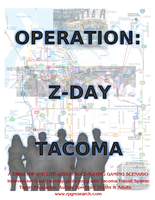
Here is a status update on the Z-Day City role-playing game project, originally started back around 2014, with some root development back in 2007, a hybrid TRPG, LRPG, and ERPG, with xR, role-playing game adventure series.
FAQ: How Did Hawke Robinson Become "The Grandfather of Therapeutic Gaming" and Involved with the Role-Playing Game Industry?

How did Hawke Robinson (published as W.A. Hawkes-Robinson) get the nickname as "The Grandfather of Therapeutic Gaming"?
Document Actions